






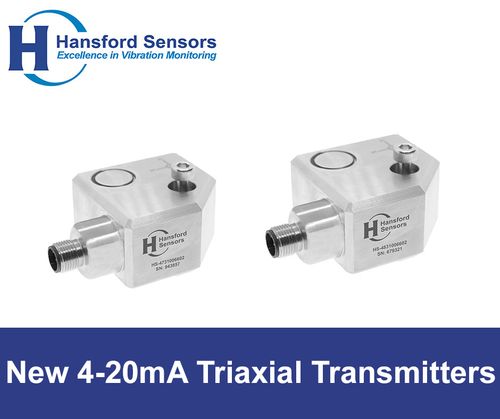
Hansford Sensors have recently designed and developed a range of new triaxial 4-20mA transmitters. The new HS-473 triaxial features 4-20mA velocity output via 8 Pin M12 Connector, and the HS-483 triaxial offers 4-20mA acceleration output. These transmitters are designed for condition monitoring applications and compatible with existing PLC/SCADA systems or other 4-20mA input modules. Sealed to a minimum of IP67, the large stainless steel body provides mechanical protection and reliability, with the ability to withstand the harsh industrial environments they can be used in. Triaxial transmitters provide an ideal solution for applications where multi-axis vibration measurement is required. View the HS-473 and HS-483 triaxial datasheets on our website: www.hansfordsensors.com

Made Smarter Innovation Focus Groups Stand E42 Made Smarter Innovation has recently launched 6 Research Centres and 2 Innovation Hubs covering the latest concepts and applied research in digital manufacturing technologies. To help maximise value from these, they are running a series of focus groups. 8th June 10.00-10.45 - Sustainability - How would you like to see Made Smarter approach Sustainable manufacturing? Current status and thoughts. 8th June 14.00-14.45 - Big Data - How can we unlock supply chain effectiveness through the use of big data, including AI and Machine Learning? What is preventing your company from progressing? 9th June 10.00-10.45 - Materials Supply Chain - How could materials be more effectively tracked through the supply chain? What business models would be effective in progressing this, including end of life obligations? 9th June 14.00-14.45 - Diversity & Inclusion: Made Smarter has a big drive on D&I. How can Made Smarter work more effectively with companies to maximise the mutual benefit of activities? Spaces are limited – Contact us to reserve a seat or drop by their stand on the day. Only 8 seats available per focus group. Register your interest here If you would like a more personal chat on how Made Smarter could help your business, 121 sessions are also available.

The rise in the main rate of corporation tax to 25% was first announced in March 2021, reversing a trend of lowering rates which had been in progress since 2008. The rise from the current 19% is significant and, whilst still modest in the context of others in the G7, is something that businesses should be planning for.As the rate is not set to change until 1 April 2023, there is the possibility of a change in intent from the Government.With a more extensive Budget expected in the Autumn, this could amend the 25% rate increase. However, in the meantime, how can you plan for it? • Consider your capital investment plans. Many manufacturing businesses are continually upgrading and renewing plant and facilities. There are currently significant capital allowances incentives for new capital investment and this will need to be considered in the context of obtaining corporation tax relief sooner versus potential for relief at a higher rate of corporation tax from 1 April 2023. • Review your intellectual property. As well as patenting end-products, the manufacturing process itself can also be patented.The patent box rate for qualifying profits will remain at 10% so the increased main rate will make this even more valuable.This leads to two considerations: a) are there patents which are being exploited already which haven’t yet been claimed? b) Is there any scope to patent existing intellectual property to allow a patent box claim? • Revisit your international group. Once established, international structures are rarely revisited but this is a good opportunity to consider if the activities in each country and consequent transfer pricing policy remain appropriate. For manufacturing groups with presence in multiple jurisdictions, there could be benefits in considering where activities are carried out and where the value is created. • Finally, ensure R&D claims are up to date. R&D relief continues to be valuable with effective relief of up to 32.5p per £1 of spend for SMEs from 1 April 2023 and 9.75p per £1 of spend under the RDEC scheme "The UK has an extensive, tax driven business environment. UK Plc is open for business. The number of tax incentivised reliefs should be thoroughly explored by all businesses to reduce their overall tax liability."





Problem The customer concluded that the regular, manual inspection routine was not enough. To understand The customer concluded that the regular cleaning and balancing did not expect results, or the impact was only short-term. With manual inspections detection of cleaning needs was achieved, yet cause and effect were suspected to be partially uncovered. To understand the situation in more detail, the customer reached out to Condence for options to gather more and better data to achieve a more comprehensive understanding. Solution Condence blower monitoring concept was installed on the machine. Condence terminal and sensors were installed by the customer’s technician and analyses configured remotely with the assist of the Condence team. Once the first analysis results were received, it was clear that the regular cleaning routine for the machine was not enough. The high vibration levels were especially evident during the coast-down period for weekend stops. Read the full story at https://condence.io/2022/02/21/case-study-critical-process-fan-imbalance/

The aim of this article is to present a couple of use cases where deception technologies can be used to provide an extra dimension to Operational Technology (OT) networks. Firstly, we need to define exactly what we mean by an OT network. An OT network is the information infrastructure deployed for non-IT systems. These can be as varied as oil-well head pumps to medical devices; machine-tools to power station control networks. These, typically industrial systems rely on communication networks to relay operational data, which can be as complex as full management of a production line to a simple open/closed status of a fluid control valve. Many of these networks use communication protocols that are specific to the system being managed, or more common protocols such as Modbus-Over-Ethernet. The word acronym SCADA (Supervisory Control And Data Acquisition) is another term associated with OT networks. SCADA describes an architecture for industrial control systems, typically linking a Human-Machine Interface (HMI) to Programmable Logic Controllers (PLCs) to send and receive controls signals. For example, in the case of an industrial oven, PLCs are used to control the valves for the gas burners. The temperature of the oven is measured by sensors in the oven and displayed on the HMI. The HMI allows the operator to send signals to the PLCs to open or close the gas valves to raise or lower the temperature of the oven. This process would normally be automated and monitored through the HMI. There is another key characteristic of OT networks: they are critical, occasionally fragile, and often employ obsolete IT technology. Industrial machines can have an operational life of many years. This means that there are systems in the wild that are using operating systems that are no longer supported by the manufacturer. Additionally, many HMI systems run on bare-bones operating systems and hardware that has been “optimised” to be the minimum necessary. This often means patches are not compatible, or you have to wait months for an “HMI compatible” patch to be made available by the manufacturer. In a real-life case, a multi-million-dollar device was supplied that required access to the local IT network to transfer work files. As part of their security policy the customer installed an endpoint anti-virus solution, and then watched as the device ground to a halt! The system requirements of the AV pushed the onboard HMI over the limit and the device crashed… This brings up a policy that exists in many OT networks: “If it’s working, for heaven’s sake don’t touch it!" OK, so what do we do? There are many ways to secure OT networks, but as we mentioned before, this article is about how deception technologies, and specifically the CounterCraft Cyber Deception Platform can be used to add zero impact security and gather valuable first-hand threat intel on those who are targeting your OT systems. The following attack scenarios offered here can equally be applied to internal or external attacks. Deception Campaigns The following campaigns can be used individually or as a phased deception deployment. Stage One The idea behind this campaign is to detect anyone looking to gains access to the OT network from within. Stage one is to create a series of breadcrumbs that point to a portal or dual-homed machine that allows access to the OT network. The breadcrumbs can take multiple forms for example: i) Credentials in the Active Directory Domain Controllers ii) Documents in a shared folder such as deployment guides, or access instructions with credentials iii) SCF files within the shared folders iv) RDP links to the dual homed device or access portal This is a good example of a mix of active and passive breadcrumbs. The passive breadcrumbs are snippets of data like the credentials, that by themselves do not do anything, but are a powerful bait to lead the adversary deeper into the deception. The SCF files and fake documents are active documents - not only to they provide bait to lure the adversary deeper, but they also call home when they are touched, to provide an instant alert that the adversary has opened a particular folder or has opened a particular document. The active breadcrumbs provide detailed threat intel by collecting data from the adversary such as connecting IP address, IP ASN, user agent, OS, cookies, etc. Both of these deception techniques are useful to build a picture of what the goals of the adversary are. For example, we can set up the folder structure to provide choices. By mapping which folders were opened first, you can gain insight into what the attacker is looking for: manufacturing drawings, process data, or just access? The web portal itself is a dead-end, but we can register the login data and track the credentials used to identify where they were discovered by the adversary, providing additional data to track the attack path and identify the point of compromise. This is a basic level campaign that is straightforward to deploy, but that provides valuable threat intelligence. Stage Two If the stage one campaign is getting hits, the next stage is to amplify the deception. We do this by give the adversary what they are looking for - a fully instrumented HMI. For the deception to be credible, the ideal is to use the same HMI software that is used in production. Using the Cyber Deception Platform, it is an easy task to instrument a pre-configured HMI server, or build one from scratch. We can use similar breadcrumbs to those deployed in Stage One to attract the adversary. Now, when the adversary accesses the web portal to the OT network, they will be able to access the deception HMI. As the HMI service is running on a fully instrumented deception host, all adversary interaction will be captured and sent to the CounterCraft CDP. In this way we capture a full record of exactly what the adversary does, and the full telemetry collected. This is an intermediate level campaign. Stage Three The idea behind stage three is to expand on the deception created for Stage Two by providing a fully instrumented OT environment to access and explore. Having gained access to the HMI server, the next step would be for the adversary to try to traverse the OT network. The design of Stage Three provides a series of PLC devices with which they can interact. Using the full OT possibilities of the Cyber Deception Platform we can set up a series of emulated PLCs and even deploy an SQL server to act as a historian. This provides a fully populated OT environment for the adversary to explore. Using the Conpot PLC emulators we can set up devices within the network that react in the same way as a PLC. The PLCs react in the same way if interrogated. The SQL database of the historian can even be used to lead to other deception hosts, deeper within the deception environment in order to maximise the adversary dwell time. Depending on the design of the campaign, it’s possible to react automatically to adversary behaviour using rules-based responses. In this way, if an adversary exhibits a particular form of behaviour the deception environment can be modified on-the-fly to add more aspects to the environment or to add increased credibility. For example, if the adversary were to perform a port scan, new virtual machines could be activated to increase the scope to the environment and to increase the time the adversary interacts with the deception. The longer they are held within the deception environment, the longer we can observe their tactics, techniques, and procedures (TTPs) and the more time we have to perfect our response. This is an advanced level campaign. The Future The CounterCraft Cyber Deception Platform is a constantly evolving solution. We are always looking to improve our deception coverage and to increase the credibility of our deception environments, and to simplify deployment. The next step within the area of OT networks will be the ability to reply process data replay to bring additional credibility, and even to simulate real processes. Conclusion We have seen with these examples that using deception, it is possible to detect malicious activity, collect valuable threat intel and also create and respond to adversary activity in real time. All of this is achieved with zero impact on existing systems, and zero risk to business continuity. Any deployments of this sort would be carried out in full cooperation with CounterCraft or one of our trusted Partners. It goes without saying that as OT is such a critical component, protecting it correctly is key. Using deception technology provides an effective way to add an extra layer of protection to your existing security systems. Next Steps Find out more by contacting CounterCraft. We are only too happy to explain what we do and how we can help you get the best out of deploying deception – from an initial conversation or simple demo, to a fully featured deployment: https://www.countercraftsec.com/contact.html