


)
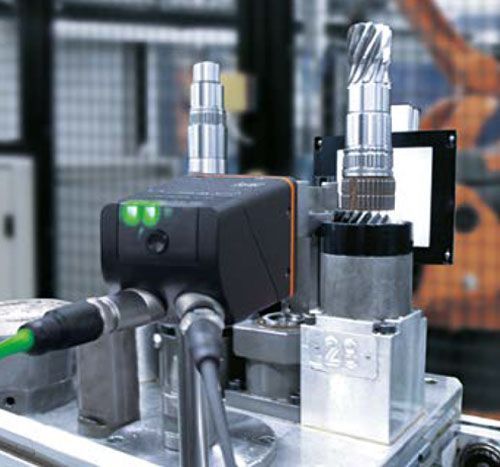
Thanks to user-friendly application software, even inexperienced users can easily and quickly configure ifm’s new Dualis 2D vision sensors to perform complex and demanding inspection and recognition tasks. In standard applications, set up can be completed in as little as two minutes, and this versatile sensor is capable of checking patterns, shapes, areas, dimensions, contours and even target contrast, either as individual parameters or in combination. Typical applications for Dualis 2D vision sensors include detection of missing components in assemblies; identification of malformed threads, missing holes or incorrectly applied adhesive; sensing incorrect product orientation or positioning; and counting the number of items present in the target area. The ifm Vision Assistant application software, supplied as standard with the sensors, incorporates ‘wizards’ which provide detailed set up guidance for many of these applications, and also offers an advanced mode that allows experienced users to access additional functionality. Dualis sensors feature integrated illumination and are available in both infrared and RGB-W versions. With the RGB-W versions items can be distinguished by colour, while the built-in polarising filter also makes it possible to detect highly reflective objects easily. To minimise the effect of extraneous light, the sensors incorporate a daylight filter and, in strongly fluctuating light conditions, they can be configured to take up to five images with different exposure times and automatically select the best of these for analysis. To ensure compatibility with the widest possible range of applications, Dualis 2D vision sensors from ifm electronic can be supplied with standard, wide-angle or telephoto lenses, with all versions available with either Ethernet/IP or PROFINET TCP/IP interfaces.

)
)

Here are some of the most common queries we receive: 1. What are the Rules of Origin and where can I find them? 2. I purchase goods from a UK manufacturer. Am I correct to assume that the goods can be exported to the EU as UK origin? 3. What records do I need to have in place if HMRC check the origin of my goods? Toread the full article click here: https://mha-uk.co.uk/insight/knowledge/5-key-questions-on-the-rules-of-origin/

If you have thought about any of the above, you will need our assistance to comply with the complex Customs regulations. Our Indirect Tax Team are available to assist UK businesses to navigate the processes and produce the documents required. Read on below for just one example on how Customs Compliance can impact businesses: Business Case Study: A UK business had been subject to a HMRC Customs Audit where tariff classification was questioned on specific products resulting in a substantial customs debt. This decision on the commodity codes affected the long term viability of the product but the business did not have the knowledge to question the decisions made by HMRC. Our Customs Team were engaged to establish whether the commodity codes provided by the HMRC Customs Officer were correct. Our team liaised with the business to obtain the specifications and samples for the affected products. To read the full article click here: https://mha-uk.co.uk/insight/knowledge/5-key-questions-on-customs-compliance/

If you have thought about any of the above, you will need our assistance to comply with the complex Inward Processing regulations. Our Indirect Tax Team are available to assist UK businesses to navigate the processes and produce the documents required. Read on below for how Inward Processing can impact businesses: Now, more than ever, Inward Processing has to be a consideration for any business involved in the manufacture of goods which are exported from the UK. With the UK’s departure from the EU, consignments to/from the EU are now subject to customs formalities. To read the full article click here: https://mha-uk.co.uk/insight/knowledge/4-key-questions-on-inward-processing/
)

)
)

.jpg/fit-in/500x9999/filters:no_upscale())