




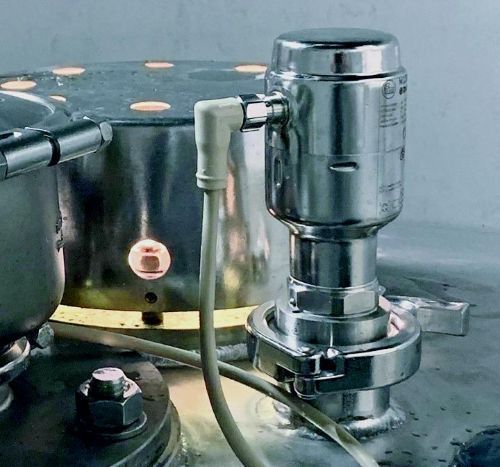
With the new LW2720 radar level sensor from ifm electronic, accurately measuring the level of liquid media in large tanks and vessels is no longer a problem; this innovative sensor has a measuring accuracy of ± 2 mm at ranges up to 10 m. In addition, it is fully certified for use in hygienic areas, making it an ideal choice for food and pharmaceutical applications, including those that involve CIP and SIP operations. The ground-breaking LW2720 measures levels using an FMCW radar-based system operating at a frequency of 80 GHz. This provides stable and accurate non-contact measurements that are unaffected by changing pressure, temperature and the presence of steam or condensates. In addition, the 80GHz operating frequency of the sensors provides a very narrow beam angle that gives a reliable level measurement even in applications where agitators, stirrers and scrapers are present. Compact and very easy to install and commission, LW2720 radar level sensors are readily parameterised via their integral IO Link interface, which can also be used to check settings and to monitor measurements. As well as the IO Link interface, the sensors can be configured to provide either one analogue output and one switching output or two switching outputs. This wide range of output options facilitates integration with almost any type of control system. All stainless construction and IP rating up to IP69K ensure that LW2720 sensors will provide long reliable service even in demanding environments and applications. They can be used with media over the temperature range -40 to +150 ºC, and a pressure rating of -1 to 8 bar. To complement these sensors, ifm offers an extensive range of accessories, including hygienic mounting adaptors, and pre-terminated M12 connecting cables
.png/fit-in/500x9999/filters:no_upscale())

The biggest challenge many British manufacturers are still facing is a shortage of skilled workers. While advancements in Industry 4.0 technologies have brought a surge of innovation to the sector, ultimately, it’s having people with the right skills that is key to driving the industry forwards. There are many reasons as to what's behind the skills gap, including experienced workers retiring faster than new workers entering the industry and manufacturing still appearing to be low on the list of career options for young people due to an outdated perception of the industry being monotonous and low-paid. Not to mention male-dominated. We are working with Napier PR to conduct a survey into this important topic to find out where we are now and how the pandemic may have affected the situation even further. The survey is anonymous but please enter your email if you would like to be entered into a draw to win: Prize 1: Apple 10.2" IPad 9th Generation (64GB) - Space Grey Prize 2: £100 Amazon Voucher Prize 3: £50 Amazon Voucher The survey will close on Friday 8th April 2022. Take the survey here now
)
)
)
After previously reviewing the combined impact of COVID and Brexit upon the manufacturing and engineering sectors, most recently in May, MHA returned to a short series of questions to track progress. Encouragingly, on reflecting on much of what we had heard and seen in terms of “pent up” demand when we asked how long it would take entities to return to their trading level pre COVID we were told that 37% of respondents had either been unaffected or had now exceeded pre COVID business. In our May report we noted that the projected recovery period had lengthened a little which we suspected was caused by a series of set backs from successive lockdowns but the latest set of responses has seen timescales shorten again with 23% now seeing a recovery in less than 6 months and 19% between 6 and 12 months compared to 24% and 34% respectively. These are, of course, alongside those who have already exceeded pre COVID levels or have been unaffected meaning that 60% of business are or expect to be back to pre COVID levels shortly. The recovery is underlined by our question regarding planned levels of investment within the next 12 months where 40% are now planning investment as planned and 27% slightly or significantly more whereas only 9% significantly less and 21% slightly less. We raised the query last time whether the announcement by the Chancellor for capital allowance super-deduction where businesses will be able to gain relief at 130% would make an impact in the area of investment and it would appear that this, alongside the levels of demand could be part of the explanation. We asked whether respondents had changed their product mix as a result of the pandemic. The answers remained pretty much unchanged with 55%, as opposed to 51%, saying “no”. This, of course, can be interpreted from both directions as we noted in the last report and of the 45% who have changed then 29% have done so by a “little”, 9% by “quite a lot” and 6% “significantly”. As the pandemic has evolved so has the response to it. Two such examples have been “social distancing” and the use of the NHS App which alerted you if you had been in contact with someone who had tested positive for COVID– a flurry of these led to the term the “pingdemic”. Therefore we asked “will you be continuing with social distancing measures within the workplace?” 68% said “no”. This should be considered in the light of responses to the previous report which revealed that 51% had seen capacity affected “a little” by social distancing measures and 25% “quite a lot” or “significantly”. A new question for this report asked whether the “pingdemic” had affected business? 61% said “a little”, 20% “quite a lot” and 4% “significantly”. In previous reports and working with our clients we have advised them to consider the robustness of their supply chain and this has again been highlighted with blockages in the Suez Canal, a shortage of delivery drivers alongside issues crossing the Channel. Responses to the question will you be changing your supply chain tend to underline that all is not right with 43% saying “a little” which was the same as the last report, but there has been a movement in the answers “quite a lot” 13% (previously 9%) and “significantly” 4% (previously 1%). In our previous report we introduced two specific questions about the impact of Brexit; Have you had to change your business practices as a result of the Brexit agreement? The split of responses to this question has not really changed with 66% saying “yes” (67% the last report) and the most significant reason given here is “additional paperwork” which very much reflects the assistance that we have provided to our clients throughout this period. We also asked whether businesses had seen friction or obstacles as a result of the Brexit agreement when trading with the EU or with Northern Ireland? Of our respondents 61% (56%) said no. The last minute nature of the Brexit agreement certainly caused issues for businesses and more recent discussions to ease the path of goods across the Irish Sea highlights the challenges still faced requiring the Government and EU to find a way of easing the problem. Government “intervention” has necessarily been at unprecedented levels and 70% of our respondents said that this was either “enough” or “fantastic” with many making use of either the “furlough scheme” or Government backed loans. With the recent ending of “furlough” it remains to be seen what impact this might have. There have been suggestions that it will lead to increases in unemployment or a Government suggestion that those no longer required in one industry might be able to retrain to fill demand elsewhere. With the perennial skill shortage within the sector alongside those previously employed within companies but who have left following the Brexit agreement any incentives that might ease this challenge would be welcome however it is clear that there needs to be a coordinated Government industrial policy to address longstanding issues within the sector. The role of Government is highlighted by a new question which we added into this report. We asked if you could change one thing which would make your business life easier? Our respondents replied with a number saying “reverse Brexit” where they highlighted issues with freedom of movement of people and goods and that this was affecting their businesses in a number of ways whilst others highlighted supply chain issues and the rising cost of goods. As we concluded in our last report it is evident that the pandemic and now Brexit have had a significant effect on the manufacturing and engineering sector. The ability of manufacturers and engineers to pivot has been much in evidence and the continued review and strengthening of supply chains is important and it is most encouraging to see the return to pre COVID levels and bulging order books, but there are many challenges affecting the sector and there is a real risk that the good work done could falter or worse be “undone” by the newer challenges within the supply chain or in terms of increased prices for vital services. Whether Government will be required to get involved again remains to be seen but as has been proved many times the manufacturing sector is vital for the UK economy.
)

The Patent recognizes their continued development efforts towards bringing a process patent that involves ultra-low-power wireless sensors and cloud-based software that detects even small changes in the machine performance and predicts the remaining useful life of any industrial asset. The patent is a significant achievement for Nanoprecise as it represents the high standard of recognition that Predictive Maintenance system being employed by Nanoprecise is unique. Nanoprecise strives to simplify the monitoring of industrial assets involved in the various complex manufacturing processes, with our patented signal processing algorithm, to help manufacturers maximize their uptime.
)
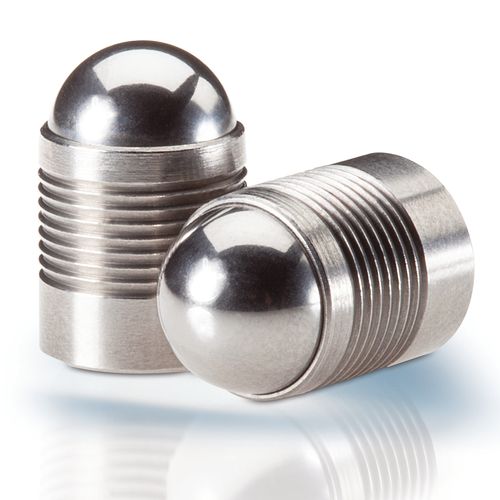
To improve the process when mounting the sensor with stud or magnet to the machine, Hansford Sensors have introduced grease adaptor mounts. The HS-AS241 grease adaptor mount with 1/4"-28 UNF female accelerometer mounting thread, ensures accuracy and top cleanliness, producing an airtight seal. The 416 Stainless Steel material provides high resistance to acid and corrosion. This grease adaptor mount has the option of straight or 45° fitting. One of the key features is the quick and easy process of using this grease adaptor which enables better precision and reaches areas that would otherwise be difficult to access. The grease adaptor mount is available with lengths of 20mm and 40mm, with other options to be specified by customers. View the product datasheet on Hansford Sensors website here: https://www.hansfordsensors.com/products/studs-magnets/mounting-accessories/
)