
Deloitte presence at Manufacturing & Engineering Week 2023 9 May 2023 This year, as Digital Manufacturing Week expands into Manufacturing and Engineering Week Deloitte will focus on how digital engineering and smart manufacturing can enable organisations to design, manufacture and operate products which are more sustainable. We will look at how sustainability can be at the heart of product design and smart factory transformations and cover sustainable product design, circular ‘zero waste’ manufacturing, net zero workforce and sustainable transformation journeys. Attend one of our Deloitte presentations We are excited to host four sessions in the solutions theatres over the two days. On day one, visitors can learn how to successfully transition to sustainable engineering and manufacturing with our perspective on the ‘7 Virtues of Smart Factory’. We’ll look at 7 considerations for organisations on their sustainable engineering and manufacturing journey and how to successfully navigate them. Later, come and hear our views on what product development will look like in the future as we embrace sustainability and the latest engineering practises. The session will cover material selection, circular design, durability and business models. On day two, you can hear how one of our clients reduced energy usage at a manufacturing facility, and how technology can help your smart factory get to net zero. Visit the Deloitte exhibition stand in the Smart Factory Expo Our stand will be the home of everything Deloitte. Visit us to learn about how we can help your organisation on its engineering and manufacturing transformation journey as well as experience our immersive demos – including the metaverse experience of our smart factories in Wichita, Dusseldorf and Kyoto; and meet Chip the Dog. We’re excited about Manufacturing & Engineering Week - it is a great opportunity to meet people in the industry and learn from each other as we help solve today’s sustainability challenges.

Fibox, the renowned electrical enclosure manufacturer, takes pride in its well-established line of sustainable and recyclable enclosures made from high-quality polycarbonate, tailored to meet the needs of electrical engineers and designers. Fibox is committed to sustainability and offers a durable solution for safeguarding delicate electrical components, while minimizing the environmental impact of its products. Fibox enclosures are built to last and are 100% recyclable, with up to 25% of the raw material consisting of recycled polycarbonate. Compared to traditional steel and GRP, Fibox polycarbonate enclosures are an environmentally friendly alternative, contributing towards a sustainable future. The company implements sustainability initiatives to reduce its carbon footprint, including minimizing waste and energy consumption during the manufacturing process. Ray Ferrier, Vice President UK & Ire, stated that Fibox enclosures are designed to provide exceptional protection and durability, both indoors and outdoors. The Fibox efficient machining and customization service helps reduce customer costs and their carbon footprint, making Fibox a leader in sustainable manufacturing practices. The Fibox approach to sustainability is crucial for our planet's prosperity, as industry leaders shift towards a circular economy that promotes longevity and recyclability of products. Fibox polycarbonate enclosures can be recycled into new enclosures or other products, contributing to a closed-loop or circular manufacturing process. The Fibox customization service provides a shorter time-to-market, lower overhead costs, and higher profits, which sets them apart from other manufacturers. Electrical engineers and designers can visit The Fibox website or contact their local sales representative to learn more about their established line of sustainable and recyclable enclosures made from high-quality polycarbonate. Fibox is a trusted partner for electrical engineers and designers worldwide, offering a wide range of solutions for protecting sensitive electrical components. Their focus on innovation and sustainability makes them a leader in the electrical enclosure industry. About the Company: The company is a leading provider of electrical enclosures, offering a wide range of solutions for protecting sensitive electrical components. The company is committed to sustainability and has implemented initiatives in manufacturing and customization to reduce its environmental impact. With a global presence and a focus on innovation, the company is a trusted partner for electrical engineers and designers around the world. Contact: George Hulme, Product Marketing Manager Fibox Ltd 07764694982 George.hulme@fibox.com

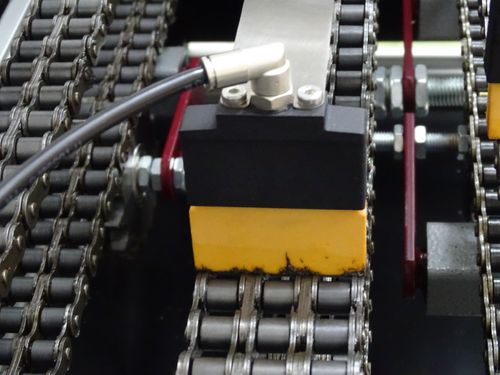
Applicators apply oil evenly and purposefully to chains and are characterised by particular durability: The application surface consists of 100% wear-resistant PU foam. The durability of the material not only allows it to be used with high-speed chains up to 5 m/s, which cannot be lubricated by brushes or pinions. Sensitive areas such as food production also benefit from the extremely low abrasion, as contamination of the environment can be ruled out. The oil applicator is supplied completely pre-assembled, including spring plate and hose connector, and can be installed quickly and easily. Applicators can be combined with all Gruetzner lubricators and used with oil only.
John Deere’s decision is timely considering the multiple headwinds that the manufacturing sector, as well as the industrial world at large, is facing. First, the world is facing food shortages because of the Russian invasion of Ukraine, which in peaceful times is referred to as the breadbasket of Europe. Ukraine is a leading producer of many types of vegetables and grains. The collapse of Ukraine’s agricultural sector has turned it from a net exporter to a net importer. This has caused the price of foodstuff to spike in the Middle East, East Asia, and North Africa, regions most dependent on Ukrainian exports. In addition, because Russia is the world’s number 1 exporter of fertilizer, global sanctions on Russia will affect the ability of other major agricultural producers, such as Brazil and China, to maintain their productivity. To step up and fill the gap, other agriculture-exporting countries need to produce more food and make every step in the process—that is, planting, weeding, fertilizer application and harvesting—more efficient with better machinery. Occurring in parallel to the imminent food shortage is the reorganization of the global supply chain. As factories in U.S. reshore, they face the labor shortage and rising labor costs caused by the massive retirement of baby boomers. The manufacturing sector itself needs to become more productive and cost-effective. The application of digital twin technology to manufacturing will be an effective solution to these crises. A digital twin platform can create digital replicas of manufacturing plants so that managers can track progress, plan for site changes, troubleshoot, and collaborate remotely. The spatial data platform of Matterport has transformed millions of buildings in more than 177 countries into data, making space more valuable and accessible. Similarly, using Matterport’s Pro2 and Pro3 cameras to capture spatially accurate information, John Deere will be able to employ digital twins of facilities at 4K resolution, enabling the optimization of operations. Using Matterport’s digital twin platform, John Deere employees can remotely track their facility’s assets and materials, monitor vehicles, and integrate real-time Internet of Things (IoT) data streams. In addition, John Deere’s teams can collaborate in real time within the digital twin to improve productivity without spending time and resources on on-site visits. John Deere plans to use Matterport’s technology to build a virtual Operations Center, which will be the virtual twin of John Deere’s manufacturing facilities, for remote management of over 60 facilities across North America, South America, Europe, and Asia. “We’re proud to support John Deere on their journey to reinvent manufacturing operations,” said Jay Remley, Matterport’s chief revenue officer. “For global businesses with facilities spread across several regions and time zones, the ability to remotely optimize each space based on its own unique parameters is a critical unlock for operations management. Our digital twin platform enables companies to reap real productivity gains and cost savings by digitizing their operations for more efficient maintenance, remote monitoring, and improved decision-making.” Read Full Article Here: https://www.engineering.com/story/john-deere-to-use-matterports-digital-twin-platform
Organizations using Matterport for spatial data can now view it on the same dashboard as AWS IoT TwinMaker data with a new integration. The AWS service builds digital twins that are useful in manufacturing, construction and other heavy duty industries. Application data from AWS can also be fed back into a Matterport digital twin through the new shared dashboard. The new integration is available now to global joint Matterport and AWS IoT TwinMaker customer. What are benefits of the new AWS IoT TwinMaker dashboard? “Working with Matterport, we’re now able to provide customers with seamless integration of their live IoT data into detailed, spatially-accurate digital twins,” said Yasser Alsaied, vice president of IoT, AWS, in a press release. Any Internet of Things data gathered by Matterport — which uses IoT devices such as cameras and other sensors as well as a human technician to build 3D images of real spaces — can now be smoothly integrated into AWS IoT TwinMaker. Once the digital representation of the physical place has been created and stored, AWS IoT TwinMaker can analyze data from that physical space and decide how to make allotting facility assets or setting up a production line more efficient. “With a digital twin of our manufacturing operations, our connected field personnel can proactively enable consistently high performance of our plant assets,” Jerry Grunewald, vice president of operations transformation at Invista, told Matterport. “AWS IoT TwinMaker and Matterport digital twins provide us with a 3D visualization of our facilities for a unified view of live sensor data, equipment maintenance records and engineering design information that enable us to make effective decisions quickly.” Real-time sensor and process data can be fed into the AWS IoT TwinMaker simulation (Figure A), allowing organizations to keep track of remote or complex sites more easily, Matterport said. The AWS IoT TwinMaker dashboard includes tools to analyze trends, predict problems or maintenance, provide remote training or video calls and perform hazardous work remotely. AWS IoT TwinMaker and Matterport data will be delivered to a single dashboard with the new integration. How does Matterport for AWS IoT TwinMaker work? Data from the Matterport Showcase SDK is combined with AWS IoT TwinMaker in a single Matterport dashboard. This dashboard can integrate TwinMaker Scene Viewer, TwinMaker Edit Mode and Grafana (a data analytics platform) with the incoming data from Matterport. The AWS product provides the data such as operational and maintenance history, statistical or physics-based models, real-time process data or sensor data and video feeds. Matterport has been part of the AWS ecosystem since 2021 when it became part of the cloud giant’s Partner Network as a launch partner for AWS IoT TwinMaker. Why use a digital twin? Twinning a digital copy of a factory floor, facility, office or outdoor location to a digital dashboard can allow organizations to improve efficiency and analyze real-time data as it comes in when done right. Digital twins have been part of the conversation around digital transformation in manufacturing for more than a decade. Digital twins remain a staple in industrial IoT and are used in network deployment. Read Full Article Here: https://www.techrepublic.com/article/matterport-aws-iot-twin-maker-dashboard/